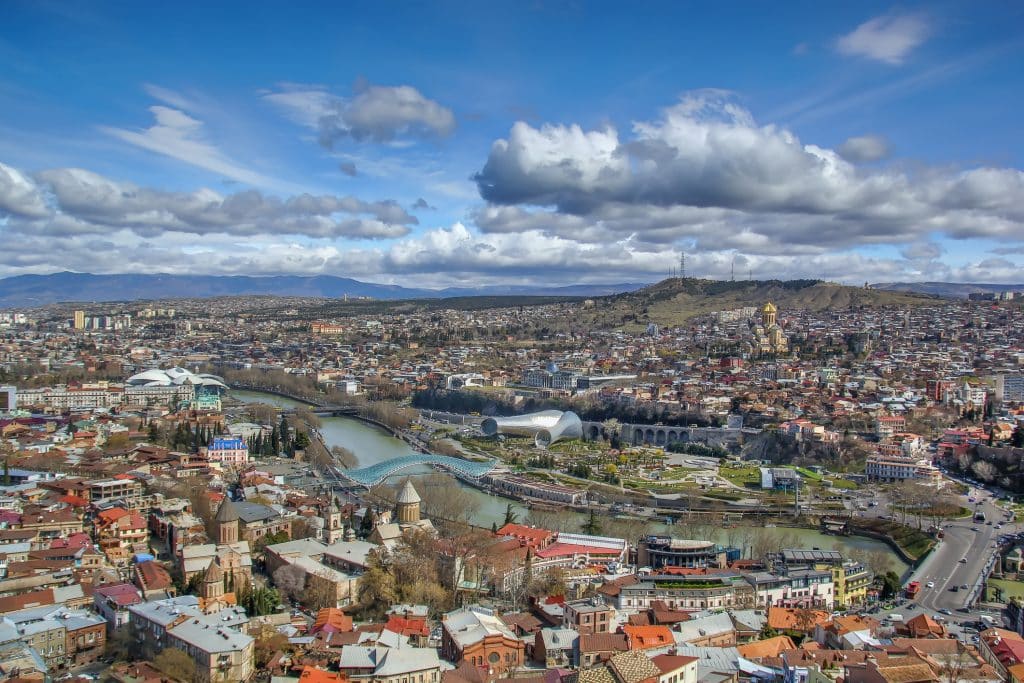
If you’d have asked me on June 10th, 2022 when I landed in Tbilisi if I’d be here, in Georgia, almost a year later, the answer would have almost definitely been “no.” However, I had so many great experiences and met so many extraordinary people that summer abroad that I felt the need to return for spring 2023.
Matilda Linne, at the time she wrote for this site, was pursuing a Bachelor of Arts in International Studies at Vassar College in New York. She studied abroad on the Identity and Conflict program with SRAS over spring semester, 2023. She also served an Online Research Internship with SRAS over the summer of 2023.
Programs Abroad in Georgia
My first summer was spent learning Georgian on the American Councils’ Eurasian Regional Language Program. I went to Georgia sort of as a passion project. I’d wanted to study Georgian for a long time. Since finding the small books that my middle school had on the Caucasus, I’d been fascinated by the region and Georgia in particular because of its middle ground, or possibly a place all its own, between Europe and Asia. My university, Vassar College in New York, also had a fellowship that would fully fund summer language programs, making this even more accessible.
SRAS’ programs are recommended by my university’s international programs office. On the SRAS website, I found the Identity and Conflict in the Post-Soviet Space program. It was exactly what I wanted for myself. The identity and conflict courses would allow me to fulfill requirements for my international studies major while giving me access to Russian language courses higher than the level available at my university. Most importantly, the program took me back to Georgia. Over the next few months, I diligently filled out every form and emailed every necessary person, to ensure that I’d be back on a plane to Georgia in January.


Studying Russian in Tbilisi
When I got to Tbilisi, I was most nervous to start my Russian classes. Because I was going to be at such an advanced level, I was going to be one on one with my teacher, which meant that there was nowhere to hide, no room to slack off. Though it was difficult and a bit awkward for me, I could tell from the first day that the class was going to be exactly what I needed. The readings were understandable, but with a lot of new vocabulary, which I was desperately in need of. Though I was nervous at first, I found the learning environment was perfect for helping me feel more comfortable speaking and allowing myself to make mistakes in Russian. I was pleasantly surprised by my experience in Russian classes, and from what I’ve heard, my fellow course-mates were also pleased with the quality of their classes as well.
Studying Diplomacy in and Traveling the Caucasus
The focal point of the program is the lectures on identity and conflict in the post-Soviet space. Each week we had lectures, either given by our two main lecturers, or by one of many professionals that SRAS and their local partners, Novamova, arranged to speak with us on various topics relating to their fields and passions. Never in my life had I had the opportunity to connect with so many people who had so much experience in this part of the world that interests me most. The post-Soviet space is so interesting because all of the countries have an overarching experience of being a part of the USSR, but the conditions they left with and the choices they had to make have left them in dramatically different socio-economic and political positions and with nuanced views of the Soviet legacy.
My hands-down favorite parts of the program were the periods of travel in Armenia and Azerbaijan. During none of the great lectures did I feel like I absorbed as much information as I felt like I did while traveling. While I had met people from Georgia while in the U.S., I had never met anyone from Armenia or Azerbaijan. I had never had any chance to hear perspectives from either of those countries firsthand. Our amazing guides, in showing us mosques, churches, the local nature, and so much more, revealed the meanings behind these beautiful places with a wealth of personal knowledge about their countries’ culture and history. The group seemed to especially enjoy the surprise we received from our experience in Azerbaijan. People we met in Georgia tended to have neutral to negative views about visiting Azerbaijan. However, our group found the northern part of Azerbaijan through Shamakhi and Sheki to be breathtaking and unique and the complexities of Azerbaijan’s culture astounding.
For me, the main value of the Identity and Conflict in the Post-Soviet Space program was in better understanding the Caucasus and its cultures. I have been interested in the Caucasus for many years, longer than I have even been studying Russian. In my opinion, as with many places in the world, the Caucasus is a place that you can’t even begin to understand until you visit it yourself. Though much of the material for the course was focused on the current conflicts in Ukraine and Eastern Europe, by basing the program in Tbilisi, and including so much travel throughout the Caucasus, SRAS has created a truly unique experience. I believe that studying in the Caucasus is invaluable to anyone with an interest in international relations, identity formation, or conflict resolution. The post-Soviet space should be a focus of American diplomacy for many years to come and understanding its regional and global value is crucial today.
Traveling the Caucasus with SRAS’ ICON Program: The Value of Educational Travel
One of the most exciting aspects of SRAS’s Identity and Conflict in the Post-Soviet Space program is the opportunity to travel to Armenia and Azerbaijan while you are based with your program in Georgia. The opportunity to see all three of the countries of the South Caucasus clarifies the diverse circumstances and attitudes in not just the region, but also allows you to better understand the diversity of the entire post-Soviet space by extension.
This firsthand experience in each country also helps temper our study of the more dramatic conflicts in the region with knowledge of what “normal” day-to-day life looks like in the region. Indeed, the only thing that many Americans may know about Armenia and Azerbaijan is their conflicts over the territory of Karabakh. Though conflicts throughout the post-Soviet space are pertinent to understanding their social, economic, and political realities, they aren’t all there is to them, and focusing only on conflict can give one skewed vision of life in the region and lead people to ignore the historical and cultural intricacies that go into forming the identities – and perceived geopolitical imperatives – of the peoples of the South Caucasus. Thus, our time in each country included both excursions and lectures led by local experts with local perspectives.
Travel is an unforgettable and necessary addition to studying the social sciences abroad.
Travel to Armenia
In Armenia we saw numerous monasteries and churches, reflecting the deep influence that Armenia’s Christian heritage plays in the national identity. The Noravank Monastery in the Vayots Dzor Region and Saghmosavank Monastery in the Aragatsotn Region stood out the most, both for their stunning views of lush canyons and peaceful austerity.
Armenia has some of the oldest churches in the world, as it was the world’s first Christian state, starting from 301 C.E. Armenian Apostolic Christianity, the majority religion of Armenia, is unique in that it’s an Oriental Orthodox church. This ties Armenia’s form of Christianity closer to Christianity in Ethiopia and Egypt than their neighbors in Georgia, where the national church is a branch of Eastern Orthodox.
As a result of this long history, Christianity is a main pillar of Armenian identity. Though it seems like the list of churches that are a “must see” in Armenia is never-ending, it is rightfully so. One cannot understand Armenia without understanding its ancient religious heritage.
Of course, the Caucasus’ long history of conflict has also greatly affected Armenia. Thus, we also saw the Sardarapat Memorial Complex. The complex commemorates the Battle of Sardarapat in 1918 which was Eastern Armenia’s, and consequentially the Armenian nation’s, last stand against the Ottoman Empire during WWI and the Armenian Genocide. I am a fan of monumental architecture and the enormous red tufa stone oxen and bell tower that greet you at the site’s entrance made the complex visually my favorite place that we visited in Armenia.


Sardarapat also houses the National Ethnographic and Historical Museum of Armenia. The museum’s architecture itself was also stunning and the never-ending displays were thoroughly educating on the ancient and modern history of Armenia. Though it happened on accident because there were no English-speaking guides the day we went, it was a good challenge to listen to the museum tour in Russian.
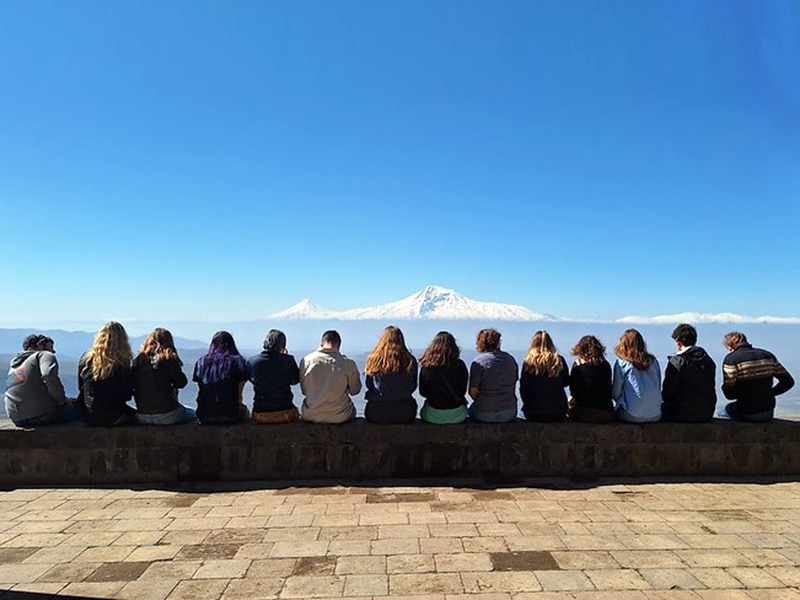
In Armenia, our presentations mostly focused on conflict resolution and nation-building in the Caucasus. Our lecture on conflict resolution was particularly interesting as it was held on the slopes of Mount Aragats at a farm that uses innovative ways to both grow crops and dry fruit. Being able to visit the business allowed us to additionally see how some Armenians are channeling their appreciation for the fruits of the earth into profitable and sustainable agricultural practices.
Travel to Azerbaijan
In Azerbaijan, we visited the Juma Mosque in the town of Shamakhi. It was built in the 8th century and is Azerbaijan’s largest mosque. It is a great example of the heritage of Persian and Islamic architecture and culture in Azerbaijan. The history of the mosque is a chronicle of the political, religious, and architectural history of Azerbaijan; our guide showed us how the culture of different time periods was imprinted on the site as it was reconstructed many times as a result of earthquakes and battles. However, whereas Armenia and Georgia are deeply religious, it was intriguing to learn that most although most Azerbaijanis identity as Muslim they don’t consider themselves to be very religious.
Much more of our trip to Azerbaijan was spent focused on the country’s energy resources that have formed helped make it one of the region’s dominant powers. Visiting places that illustrated Azerbaijan’s history producing oil and gas was particularly interesting. Here, we saw what was the world’s first mechanical oil well and learned that even though today Azerbaijan produces a small fraction of the world’s oil and gas, at the beginning of the 20th century, Azerbaijan produced more than half of the world’s oil. Azerbaijan is where the fossil fuel age began as it has deposits so near the surface that there are areas of Azerbaijan that are permanently on fire (the name “Azerbaijan” in fact means “land of fire”). Although Azerbaijan’s share of the world’s oil production has decreased, doesn’t mean that oil and gas hasn’t shaped the country’s post-Soviet experience. Staying in the center of Baku, we were able to see how Azerbaijan’s oil and gas wealth has been used to construct an elegant and futuristic capital.


By far the most exciting site we visited was the mud volcanoes in Qobustan, which are also a result of the geological effects of the country’s oil and gas reserves. Azerbaijan has the most mud volcanoes of any country in the world, accounting for nearly half of them in total.
Baku has long been a city of wealth, however, even before its oil boom came. This came from the city’s status of a political center of several major empires as well as a trade center. This wealth was apparent in our tours of Baku’s grand old town and the even grander Palace of the Shaki Khans, originally built in 1797 by the powerful Muhammad Husayn Khan Mushtaq.
In Azerbaijan we had a crowd favorite presentation at ADA University in Baku on carbon and renewable energy in the Caspian region. ADA University began as Azerbaijan Diplomatic Academy, but has now adopted the acronym as its official name is one of the most Western style universities in Azerbaijan. The lecture concisely outlined the role all three South Caucasus countries play in both regional and global energy production, transportation, and security.
Understanding the Caucasus as a Whole
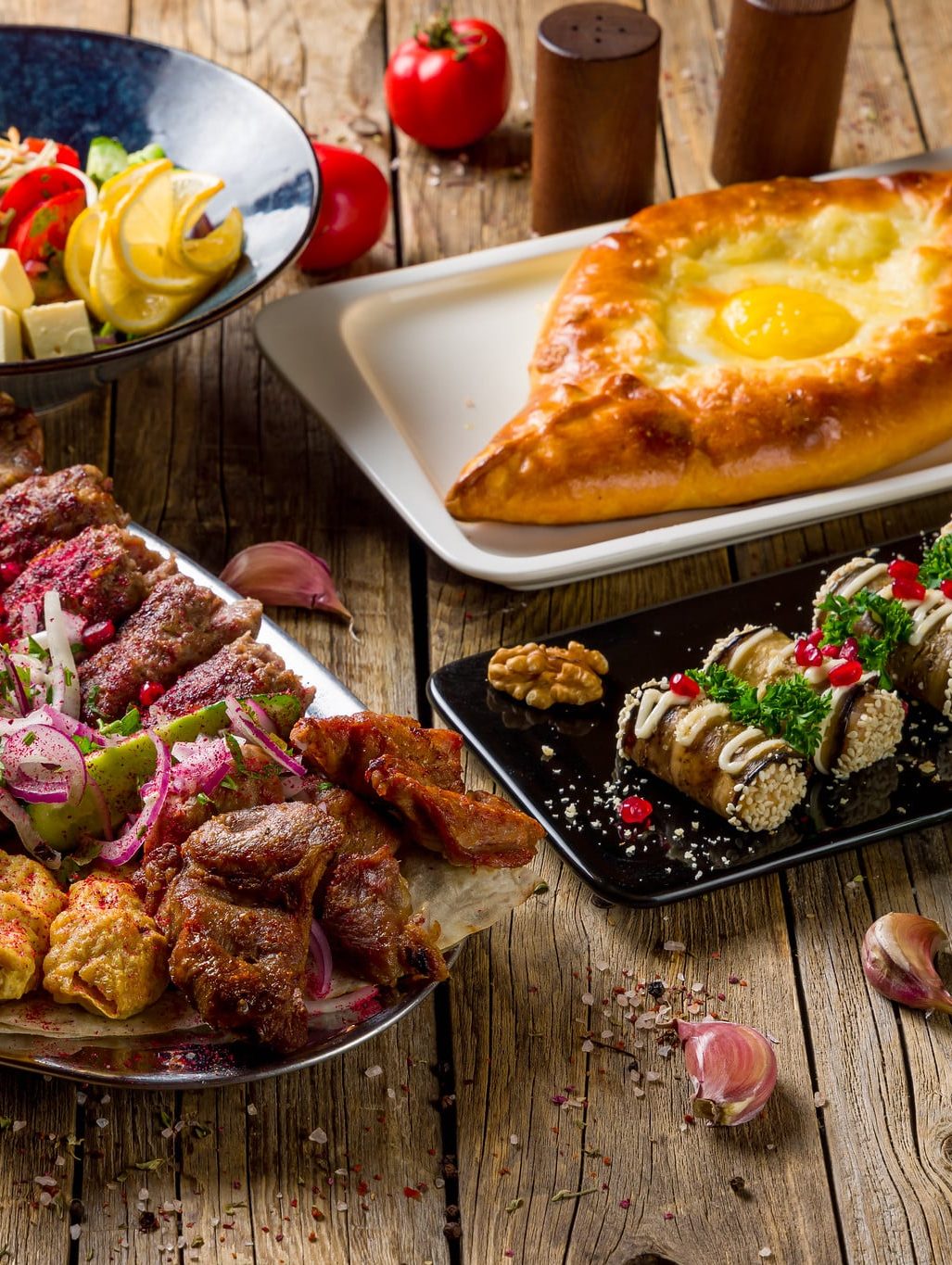
Despite their small size and close proximity, all three countries of the South Caucasus have their similarities and marked differences. While Azerbaijan is rich in oil and gas, Armenia has none and is comparatively resource poor. All three countries have very different approaches to religion. The cuisines also were quite distinct from each other. As a vegetarian, I found Georgia to be the easiest to find food in because of the large part that beans play in the national cuisine. Armenia and Azerbaijan are more meat focused.
One thing that really surprised me was the different architecture between the three countries. I did not expect even the apartment blocks to look so different from one another. Armenia, because of its large supply of tufa stone, had many buildings made from it. Azerbaijan had more single houses than Georgia or Armenia. These architectural nuances also speak to the individual countries social and political histories, as well as the natural resources that they have available to them.
The ICON program’s trips to Armenia and Azerbaijan were more than I could have ever expected. Тhe days were intense, although not in a bad way, but in a way that results from visiting a place you know so little about and have so much to learn from. The new information never stops when you’re being exposed to places that are rarely spoken about in the American media and education system. Even though our lectures in Georgia opened us to much more than we’d ever known about Armenia and Azerbaijan, actually visiting those two countries illuminated aspects of the local culture that lectures alone couldn’t, giving us a deeper and more nuanced understanding of them and the region as a whole.
Experience Georgia!
SRAS has programs for individual students and supports faculty-led programs.