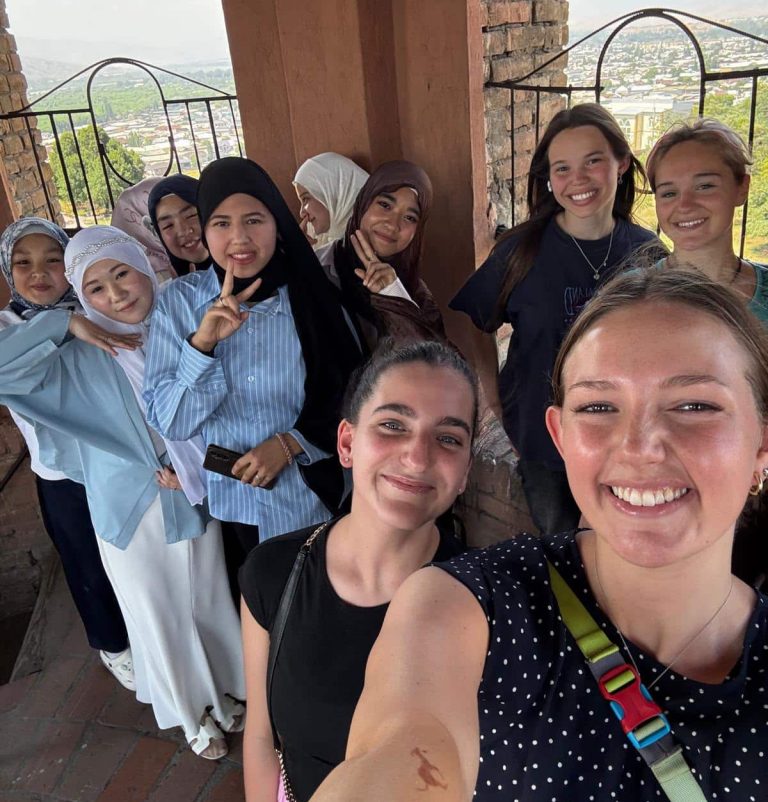
Studying abroad should complement your academic goals, not interrupt them. SRAS programs provide academically rigorous coursework while making it as straightforward as possible to earn credit and transfer it to your home institution. Whether you’re studying language, international relations, regional studies, or another discipline, we’ll help you understand your academic options and plan a program that fits your goals.

Academic Credit
Earn academic credit while studying abroad and stay on track toward your degree
Table of Contents
Planning Your Academic Experience
A successful study abroad experience begins with academic planning. Before applying, review your degree requirements, speak with your academic advisor or study abroad office, and consider how an SRAS program can fit into your major, minor, language study, general education requirements, or other academic goals. Program pages include detailed information about courses, credits, prerequisites, and language requirements, while SRAS staff are available to answer questions throughout the planning process.
The Classroom Experience
SRAS classes are intentionally small and emphasize active engagement with both the subject matter and the local environment. Language instruction is paired with opportunities to use what you learn outside the classroom, while many content courses incorporate guest speakers, site visits, and field experiences that connect coursework with the places and communities students are studying. Classroom expectations may differ from those at your home institution, providing an opportunity to experience another educational culture.
Credit Transfer
SRAS designs its programs to support the transfer of academic credit. Most SRAS programs award credit through accredited U.S. Schools of Record, while some issue transcripts directly through the host university abroad. In either case, SRAS provides syllabi, transcript information, and other documentation needed to support the transfer process. Because each university has its own policies, students should work with their academic advisor or study abroad office to confirm how credit will apply toward their degree.
U.S. Schools of Record
The University of Montana serves as the U.S. School of Record for SRAS programs in Central Asia. Stetson University serves as the U.S. School of Record for programs in Latvia, Georgia, Armenia, Poland, and Moldova.
Host University Transcripts
Students attending programs hosted by Civitas University in Warsaw receive transcripts directly from Civitas University, with credits recorded in ECTS. Home institutions routinely evaluate ECTS credits for transfer; a commonly used guideline is 2 ECTS to 1 U.S. semester credit, although conversion policies vary by institution. Students enrolled in the Civitas University semester option that includes language study receive their transcript through Stetson University.
Transcript Processing
Transcripts are generally available approximately 4–6 weeks after the conclusion of the spring, summer, or fall term. Expedited processing may be available in situations such as graduation.
Program-Specific Information
Each program page includes transcript information specific to that program in the Academics section.
Language Placement
SRAS programs accommodate students from complete beginners to advanced and heritage speakers. Language requirements, where applicable, are listed on individual program pages. Before enrollment, students complete a preliminary language assessment to assist with planning. Final placement takes place after arrival through instructor evaluation and classroom observation, ensuring that students begin at the level best suited to their current proficiency. Placement is designed to ensure that students are appropriately challenged and able to make meaningful progress throughout the program.
Before enrollment, students complete a preliminary language assessment to assist with academic planning. Final placement takes place after arrival, when instructors can evaluate proficiency more accurately through assessment and classroom observation. Placement may be adjusted during the first few days of class if another level is a better fit.
Placement is based on proficiency rather than the number of semesters previously completed or grades received. Students with similar academic backgrounds may have significantly different strengths in speaking, listening, reading, writing, or grammar and may therefore be placed at different instructional levels. These adjustments generally do not affect the number of credits earned or the course level recorded on the transcript.
Language proficiency is commonly described using the Common European Framework of Reference for Languages (CEFR) and the American Council on the Teaching of Foreign Languages (ACTFL) proficiency framework. Check out this Language Proficiency Scales article for more information about all of these rating systems.
Questions About Academic Credit?
Every university has its own policies regarding credit transfer and degree requirements. If you have questions about how an SRAS program fits into your academic plan, we’re happy to help you work through the process.