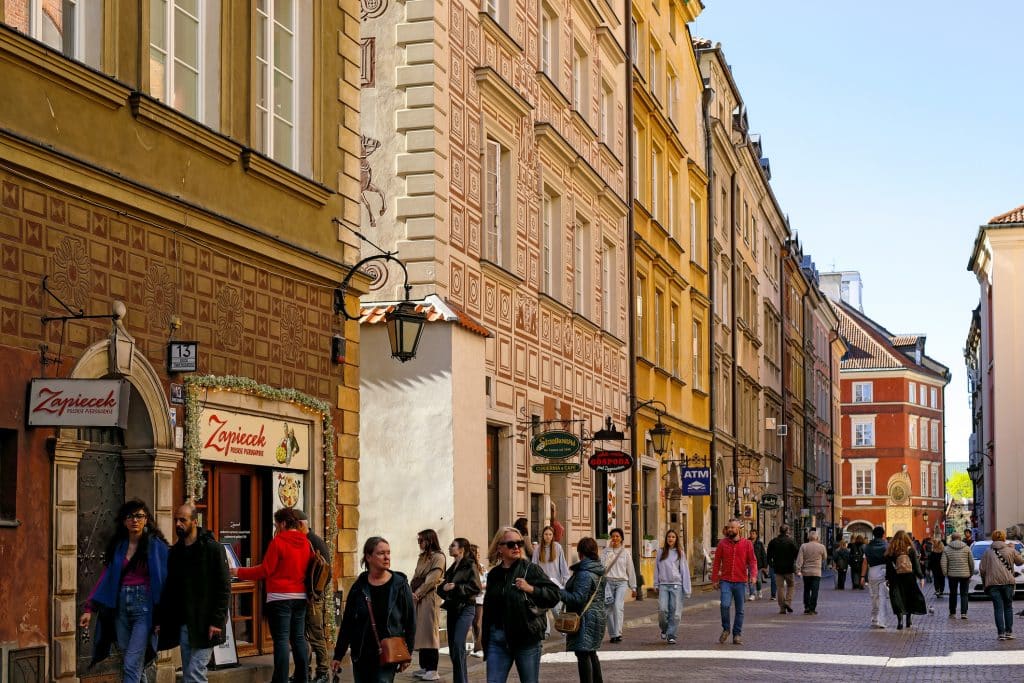
Walk through Warsaw today and Polish is far from the only Slavic language you will hear. Ukrainian is part of everyday life in shops, cafés, workplaces, schools, and public transportation. Belarusian and Russian are also present, although often in less immediately visible ways. Cultural organizations, independent media, bookstores, schools, and community events further connect Warsaw with societies to its east.
Warsaw has long been shaped by movement across borders, but recent migration has given the city a particularly important place in contemporary Ukrainian and Belarusian life. It is also a place to observe what happens to language and identity when people build lives outside their home countries.
The Ukrainian and Belarusian communities reached Warsaw under different circumstances and have different patterns of language use. Placing them within the same discussion can nevertheless reveal how languages are maintained, how identities are expressed, and how cultural life develops across borders.
The scale of recent migration is considerable. Preliminary estimates from Statistics Poland placed the number of foreign nationals living in Warsaw at approximately 301,000 at the end of 2025—14.5 percent of the city’s population. Nationwide, Ukrainians accounted for 73 percent of foreign residents. By June 2026, approximately 144,000 Belarusian citizens were registered with Poland’s social insurance system, making them the second-largest group after Ukrainians.
Different Paths to Warsaw
Ukrainian migration to Poland began expanding well before 2022. Ukrainians came to Warsaw for employment, education, family, and other opportunities, establishing networks and institutions over time. Russia’s war against Ukraine brought a much larger movement of people seeking safety, many of whom initially expected their stay in Poland to be temporary.
The result is not a single Ukrainian community. Long-term residents now live alongside more recent arrivals. Some plan to remain in Poland; others hope to return to Ukraine. Some came from predominantly Ukrainian-speaking regions, while others grew up speaking Russian or using both languages. Age, region, education, family history, and the circumstances of migration all affect how individuals relate to language and identity.

Belarusian migration to Poland also predates the current period, but it increased significantly following the disputed 2020 presidential election and the repression that followed. Warsaw became home to Belarusian journalists, writers, artists, academics, activists, business people, and civil society organizations, along with people who came for work, education, or family reasons.
Warsaw has allowed independent media, cultural initiatives, publishers, and civic organizations to continue work that has become difficult or impossible inside Belarus. Many remain closely connected to audiences and developments within the country. Politics and exile, however, do not define the experience of every Belarusian living in Warsaw, and plans to remain or return vary widely.
The word “diaspora” can obscure some of this uncertainty. Not everyone who has relocated considers themselves part of a permanent community abroad. A stay that was expected to last several months may extend for years, while relationships with Poland develop alongside continuing family, cultural, and professional connections elsewhere.
Language Away from Home
Migration does not simply transport a language from one country to another. It changes where, when, and why people use it.
Within families, language can help maintain continuity across borders and generations. Schools, cultural events, media, religious institutions, and social organizations create other places in which a language can be learned and used. Meanwhile, Polish becomes increasingly important in education, work, and public life. English and Russian may serve additional professional or social roles.


In such a multilingual environment, it is risky to draw conclusions about identity from the language someone happens to use in a particular setting. A Ukrainian who speaks Russian at home may strongly identify with Ukraine and increasingly use Ukrainian in public life. A Belarusian who conducts most daily conversations in Russian may regard Belarusian as central to their cultural or national identity. The same person might use Polish at work, Ukrainian or Belarusian at a cultural event, and another language with family or friends.
Relocation can also change someone’s relationship with a language. A person may begin using a language more frequently, or return to one they previously used less, as a way of maintaining connections with culture and community.
Ukrainian in Warsaw
Ukrainian is now visible in Warsaw not only in private conversation but also in services, education, media, cultural programming, and public information. Ukrainian organizations assist newcomers while promoting literature, music, film, art, and broader knowledge of Ukraine.
For Ukrainian speakers, these networks provide ways to maintain the language while adapting to life in Poland. Those who grew up speaking primarily Russian may make new decisions about language use or develop a stronger interest in Ukrainian. Children and young people may move among Ukrainian, Polish, Russian, and English in family life, school, friendships, and media.

Students of Slavic languages can therefore encounter Ukrainian as a language of everyday communication rather than only as an academic subject. Those who already know Russian will recognize relationships between the two languages, but they will also find differences in pronunciation, vocabulary, grammar, and usage. Russian can provide a useful starting point while also creating false assumptions about what Ukrainian words mean or how the language works.
Belarusian in Warsaw
The relationship between Belarusian language and Belarusian identity follows a different pattern. Russian remains the primary everyday language for many Belarusians. Belarusian is used regularly by some and holds strong cultural importance for others, including people who do not speak it fluently.
Belarusian cultural organizations, media, publishers, writers, artists, and educators have created spaces in Warsaw where the language can be heard, studied, published, and performed. These spaces serve fluent speakers as well as those developing or renewing a connection with Belarusian through family history, culture, and literature.
Warsaw represents one part of the Belarusian experience in Poland. Northeastern Poland offers another: communities with a much longer Belarusian cultural and linguistic presence. Together, Warsaw and Podlasie show how Belarusian identity has developed through different histories and is not expressed in only one language.
Studying Language and Identity in Warsaw
These patterns can be difficult to appreciate from a distance. In Warsaw, students can hear Ukrainian and Belarusian in contemporary use and encounter the media, cultural institutions, and communities that support them. Two SRAS programs offer structured ways to explore these environments firsthand.
SRAS offers Ukrainian language study in Warsaw through intensive winter-break, spring-break, and summer programs. Small-group instruction is paired with cultural activities and opportunities to use and hear Ukrainian in contemporary Warsaw. Programs are open to beginners as well as students continuing previous study.
Warsaw: Belarusian Studies is a two-week summer program designed for educators, graduate students, researchers, and advanced students with at least B2 proficiency in Russian, Ukrainian, or Polish. It combines introductory Belarusian with lectures, workshops, cultural programming, and engagement with Belarusian communities in Warsaw and Podlasie.
Experience Poland!
SRAS has programs for individual students and supports faculty-led programs.